Portfolio item number 1
Short description of portfolio item number 1

Short description of portfolio item number 1
Short description of portfolio item number 2
Published in Monthly Notices of the Royal Astronomical Society, 2019
Recommended citation: Lin, Z and Kaltenegger, L. (2019). "High-resolution reflection spectra for Proxima b and Trappist-1e models for ELT observations." Monthly Notices of the Royal Astronomical Society.
Download Paper
Published in The Astrophysical Journal, 2019
Recommended citation: Kaltenegger, L. and Madden, J. and Lin, Z. and Rugheimer, S. and Segura, A. and Luque, R. and Pallé, E. and Espinoza, N.. (2019). "The Habitability of GJ 357D: Possible Climate and Observability." The Astrophysical Journal.
Download Paper
Published in The Astrophysical Journal, 2020
Recommended citation: Kaltenegger, Lisa and Lin, Zifan and Madden, Jack. (2020). "High-resolution Transmission Spectra of Earth Through Geological Time." The Astrophysical Journal.
Download Paper
Published in The Astrophysical Journal, 2020
Recommended citation: Kozakis, Thea and Lin, Zifan and Kaltenegger, Lisa. (2020). "High-resolution Spectra and Biosignatures of Earth-like Planets Transiting White Dwarfs." The Astrophysical Journal.
Download Paper
Published in The Astrophysical Journal, 2020
Recommended citation: Kaltenegger, Lisa and Lin, Zifan and Rugheimer, Sarah. (2020). "Finding Signs of Life on Transiting Earthlike Planets: High-resolution Transmission Spectra of Earth through Time around FGKM Host Stars." The Astrophysical Journal.
Download Paper
Published in Monthly Notices of the Royal Astronomical Society, 2021
Recommended citation: Lin, Zifan and MacDonald, Ryan J and Kaltenegger, Lisa and Wilson, David J. (2021). "Differentiating modern and prebiotic Earth scenarios for TRAPPIST-1e: high-resolution transmission spectra and predictions for JWST." Monthly Notices of the Royal Astronomical Society.
Download Paper
Published in The Astrophysical Journal Letters, 2021
Recommended citation: Kaltenegger, Lisa and Lin, Zifan. (2021). "Finding Signs of Life in Transits: High-resolution Transmission Spectra of Earth-line Planets around FGKM Host Stars." The Astrophysical Journal Letters.
Download Paper
Published in The Astrophysical Journal Letters, 2022
Recommended citation: Lin, Zifan and Seager, Sara and Ranjan, Sukrit and Kozakis, Thea and Kaltenegger, Lisa. (2022). "H2-dominated Atmosphere as an Indicator of Second-generation Rocky White Dwarf Exoplanets." The Astrophysical Journal Letters.
Download Paper
Published in Monthly Notices of the Royal Astronomical Society, 2022
Recommended citation: Lin, Zifan and Kaltenegger, Lisa. (2022). "High-resolution spectral models of TRAPPIST-1e seen as a Pale Blue Dot for ELT and JWST observations." Monthly Notices of the Royal Astronomical Society.
Download Paper
Published in The Astrophysical Journal, 2022
Recommended citation: Ranjan, Sukrit et al. (2022). "Photochemical Runaway in Exoplanet Atmospheres: Implications for Biosignatures." The Astrophysical Journal.
Download Paper
Published in Monthly Notices of the Royal Astronomical Society, 2023
Recommended citation: Kaltenegger, L. and Payne, R. C. and Lin, Z. and Kasting, J. and Delrez, L.. (2023). "Hot Earth." Monthly Notices of the Royal Astronomical Society.
Download Paper
Published in The Astronomical Journal, 2023
Recommended citation: Essack, Zahra et al. (2023). "TOI-1075 b: A Dense, Massive, Ultra-short-period Hot Super-Earth Straddling the Radius Gap." The Astronomical Journal.
Download Paper
Published in The Astrophysical Journal, 2023
Recommended citation: Libralato, Mattia et al. (2023). "JWST-TST Proper Motions. I. High-precision NIRISS Calibration and Large Magellanic Cloud Kinematics." The Astrophysical Journal.
Download Paper
Published in The Astrophysical Journal, 2023
Recommended citation: Grant, David et al. (2023). "JWST-TST DREAMS: Quartz Clouds in the Atmosphere of WASP-17b." The Astrophysical Journal.
Download Paper
Published in Monthly Notices of the Royal Astronomical Society, 2024
Recommended citation: Vaughan, Sophia R. et al. (2024). "Behind the mask: can HARMONI@ELT detect biosignatures in the reflected light of Proxima b?." Monthly Notices of the Royal Astronomical Society.
Download Paper
Published in The Astronomical Journal, 2024
Recommended citation: Tey, Evan and Shporer, Avi and Lin, Zifan et al. (2024). "GJ 238 b: A 0.57 Earth Radius Planet Orbiting an M2.5 Dwarf Star at 15.2 pc." The Astronomical Journal.
Download Paper
Published in The Astronomical Journal, 2024
Recommended citation: Valentine, Daniel et al. (2024). "JWST-TST DREAMS: Nonuniform Dayside Emission for WASP-17b from MIRI/LRS." The Astronomical Journal.
Download Paper
Published in The Astronomical Journal, 2024
Recommended citation: Kunimoto, Michelle and Lin, Zifan and Millholland, Sarah et al. (2024). "Two Earth-size Planets and an Earth-size Candidate Transiting the nearby Star HD 101581*." The Astronomical Journal.
Download Paper
Published in Astronomy & Astrophysics, 2025
Recommended citation: Cambioni, Saverio et al. (2025). "Can metal-rich worlds form by giant impacts?." Astronomy & Astrophysics.
Download Paper
Published in The Astrophysical Journal Letters, 2025
Recommended citation: Lin, Zifan and Seager, Sara. (2025). "Carbon-rich Sub-Neptune Interiors Are Compatible with JWST Observations." The Astrophysical Journal Letters.
Download Paper
Published in The Planetary Science Journal, 2025
Recommended citation: Lin, Zifan and Seager, Sara and Weiss, Benjamin P.. (2025). "Interior and Gravity Field Models for Uranus Suggest a Mixed-composition Interior: Implications for the Uranus Orbiter and Probe." The Planetary Science Journal.
Download Paper
Published in The Astrophysical Journal Letters, 2025
Recommended citation: Espinoza, Néstor et al. (2025). "JWST-TST DREAMS: NIRSpec/PRISM Transmission Spectroscopy of the Habitable Zone Planet TRAPPIST-1 e." The Astrophysical Journal Letters.
Download Paper
Published in The Astrophysical Journal Letters, 2025
Recommended citation: Glidden, Ana et al. (2025). "JWST-TST DREAMS: Secondary Atmosphere Constraints for the Habitable Zone Planet TRAPPIST-1 e." The Astrophysical Journal Letters.
Download Paper
Published in The Astronomical Journal, 2025
Recommended citation: Louie, Dana R. et al. (2025). "JWST-TST DREAMS: A Precise Water Abundance for Hot Jupiter WASP-17b from the NIRISS SOSS Transmission Spectrum." The Astronomical Journal.
Download Paper
Published in The Astrophysical Journal Letters, 2025
Recommended citation: Lin, Zifan and Cambioni, Saverio and Seager, Sara. (2025). 'Most High-density Exoplanets Are Unlikely to Be Remnant Giant Planet's Cores.' The Astrophysical Journal Letters.
Download Paper
Published in The Astronomical Journal, 2025
Recommended citation: Gressier, Amélie et al. (2025). 'JWST-TST DREAMS: A Supersolar Metallicity in WASP-17 b's Dayside Atmosphere from NIRISS SOSS Eclipse Spectroscopy.' The Astronomical Journal.
Download Paper
Published in The Astronomical Journal, 2026
Recommended citation: Allen, Natalie H. et al. (2026). "JWST TRAPPIST-1 e/b Program: Motivation and First Observations." The Astronomical Journal.
Download Paper
Published in arXiv (submitted to the AAS journals), 2026
Recommended citation: Lin, Zifan and Daylan, Tansu. (2026). "The Persistent Thermal Anomalies in Rocky Worlds." arXiv.
Download Paper
Planets are expected to emit at a blackbody temperature set by the irradiation they receive. However, JWST secondary eclipse and phase curve observations revealed that some rocky exoplanets emit at super-blackbody temperatures. This puzzling thermal emission excess implies that some unknown processes, possibly interior to the planet, are generating extra heat. In Lin & Daylan (2026), I investigated three possible processes, namely residual heat from formation, tidal heating, and induction heating, using models. However, the mystery is not fully resolved. I found that internal processes fail to explain the thermal emission excesses at a population level. Stellar contamination, surface processes, geometric effects, or other heating mechanisms may reconcile the remaining gap. 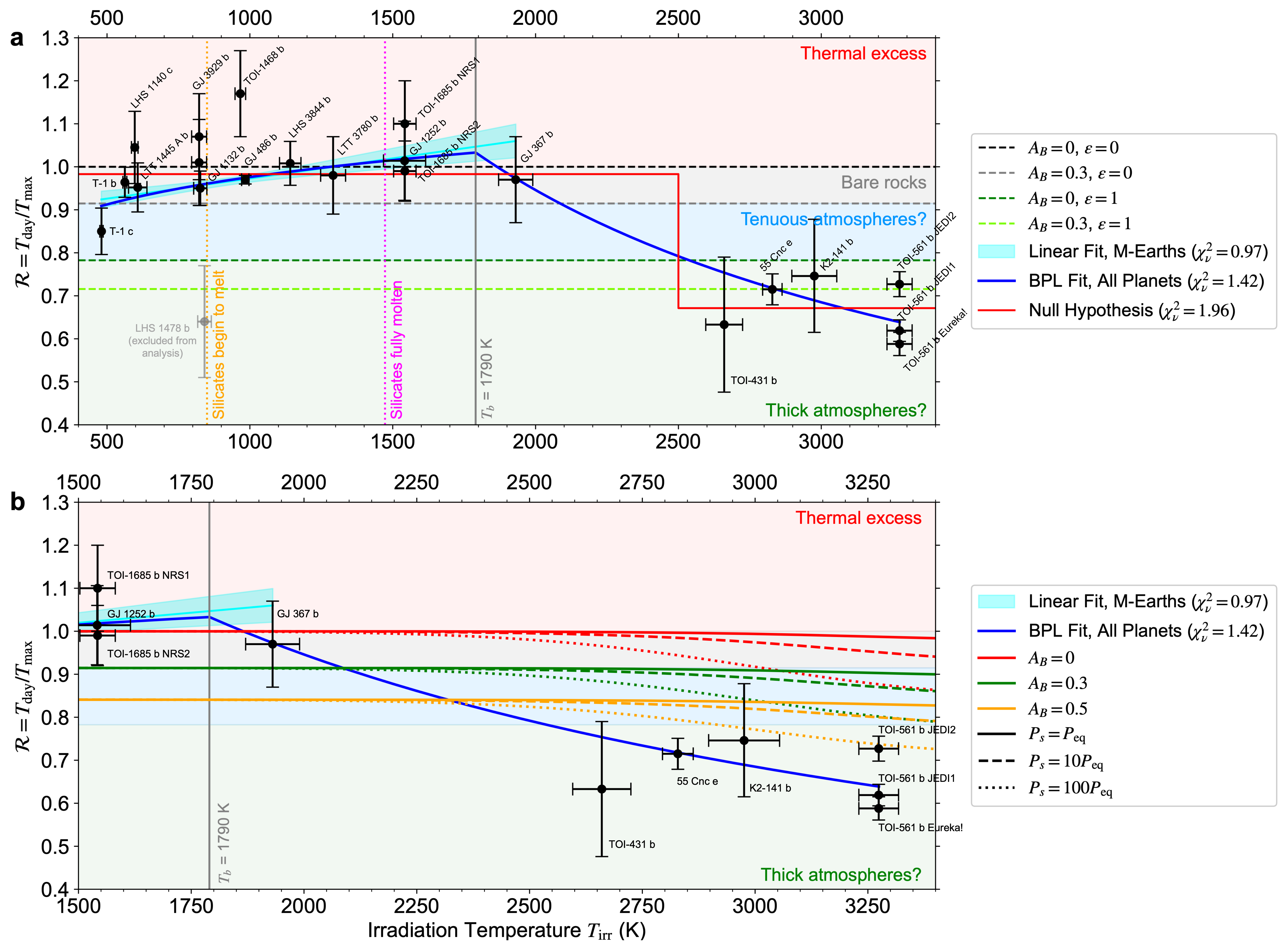
Among all rocky exoplanets known to date, there is a population of super-Mercuries with unexpectedly high densities. If their high densities are due to large iron cores - just like our own Mercury - their formation history must diverge from that of Earth-like planets. Preferential accretion of iron or mantle-stripping giant impacts could occur in the early history of these planets to increase their core mass fractions (CMFs). In Lin, Cambioni & Seager (2025), I investigate another possibility: these planets are dense not because of high CMFs, but because they are remnant cores of giant planets that remain in a fossil-compressed state. Using planetary interior and thermal models, I found that high-density planets are unlikely to be naked cores of giant planets, because they are largely molten and will expand as the envelope is stripped away by photoevaporation, and hence cannot remain in a fossil-compressed state. 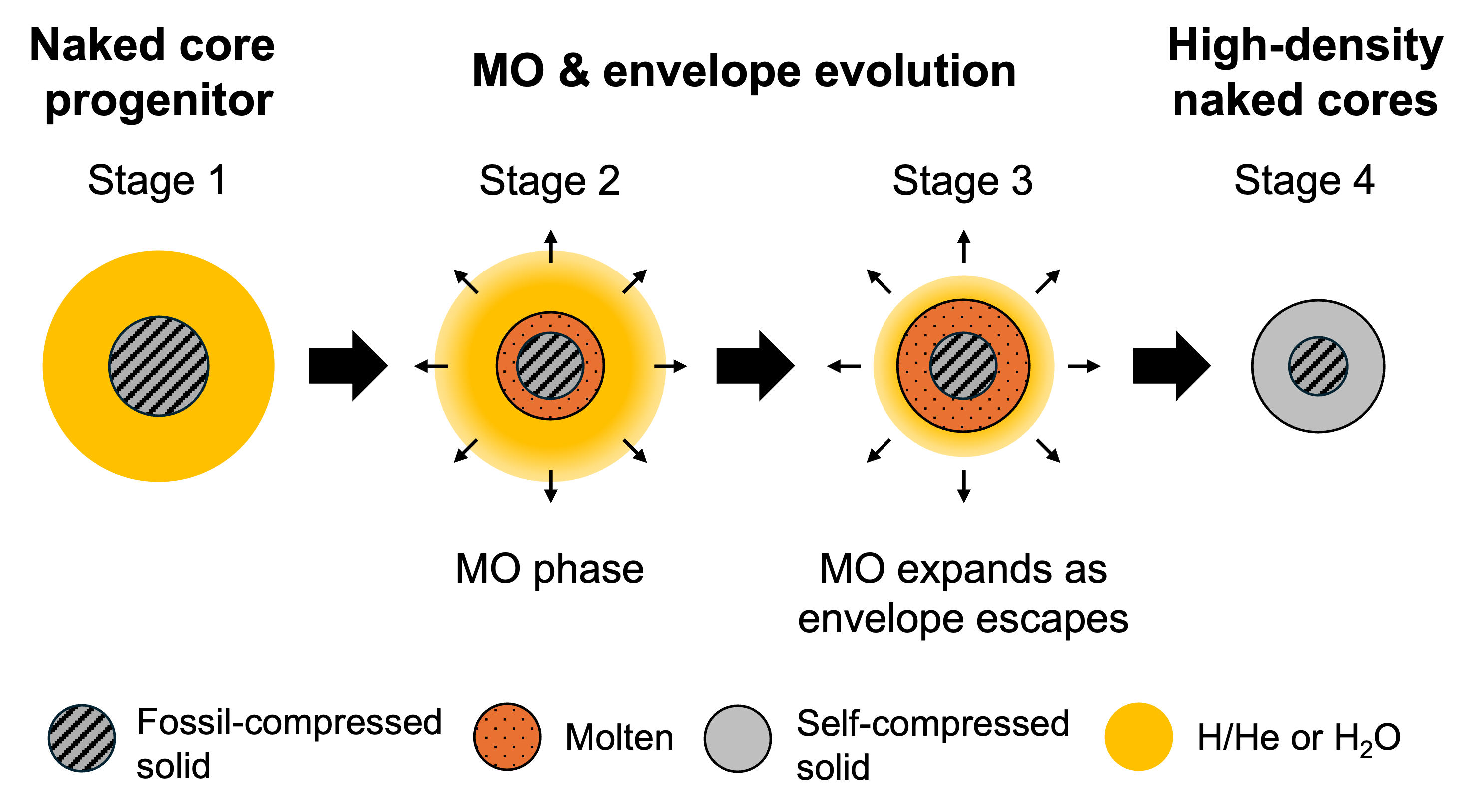
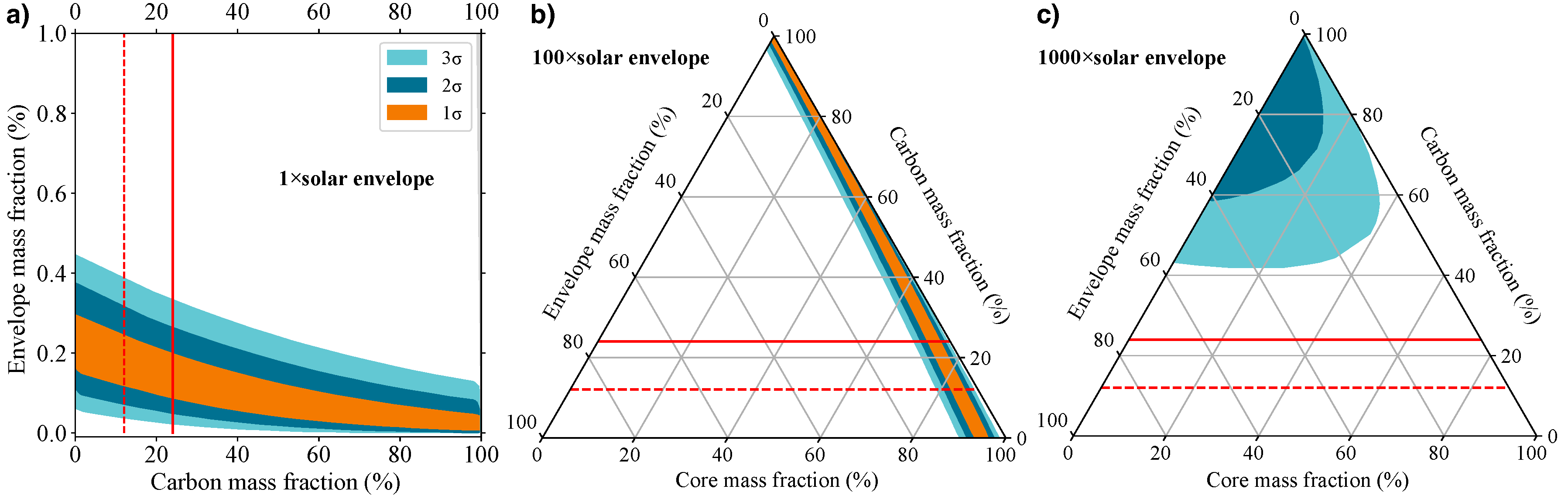
The interior compositions of planets with intermediate masses and radii, such as Uranus, Neptune, and extrasolar sub-Neptunes and Neptune-like planets, suffer from the most severe degeneracy. Many possible compositions - including predominantly rocky composition with thick H/He envelope, a roughly even mixture of rock and ice, and the water world composition - can all explain the observed masses and radii of these planets. To make the degeneracy even worse, both layered structure with sharp density jumps and smooth structure with gradual density gradients are possible. In Lin, Seager & Weiss (2025), I used my planetary interior model CORGI to study different possible interior compositions and structures of Uranus, and predict the respective gravity field, which will be measureable by the Uranus Orbiter and Probe. In Lin & Seager (2025), I studied a novel carbon-rich composition for sub-Neptunes. I found that substantial carbon layers are allowed for K2-18 b and TOI-270 d - both are well-studied archetypical sub-Neptunes - and their atmospheric compositions are consistent with high C/O ratios, which is a possible consequence of carbon-rich interiors. 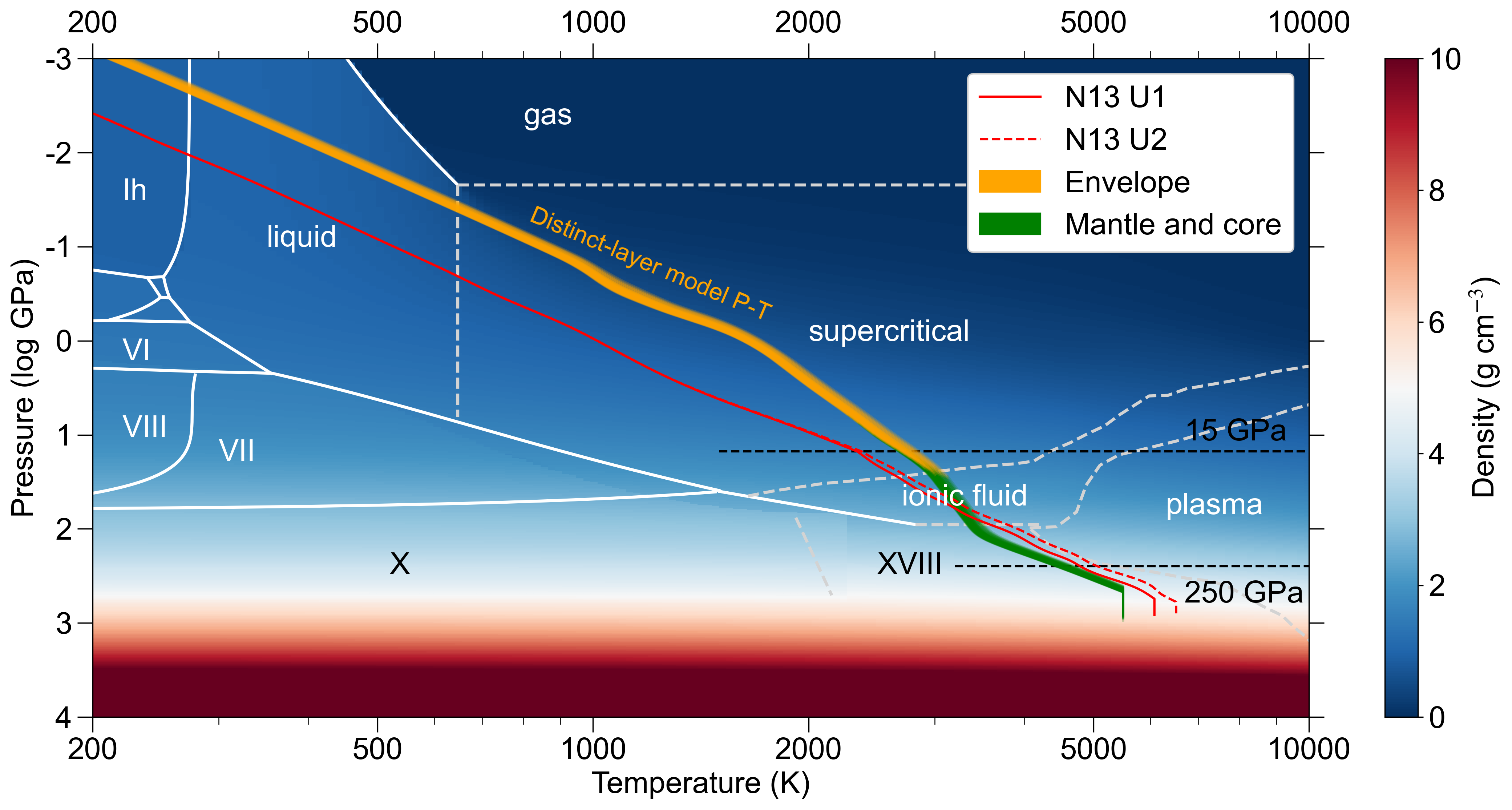
Hypothetical Earth-sized exoplanets orbiting white dwarfs (WDs) are ideal targets for atmospheric characterzation. This is because WDs - the highly compressed remnants of stellar evolution - are much smaller than main sequence stars, thereby enhancing the planet-to-star contrast ratio. In Lin et al. (2022), I simulated the atmospheric chemistry and transmission spectra of H2-, CO2-, and N2-dominated atmospheres on Earth-sized exoplanets orbiting cool (less than or equal to 6000 K) WDs. I studied the atmospheric loss of Earth-sized planets throughout the post-main-sequence evolution and concluded that any first-generation H2-dominated atmosphere cannot survive. Thus, H2-dominated atmosphere is a signature of second-generation planets accreting water-rich materials from WD debris disks and reviving a reduced H2-rich atmosphere. 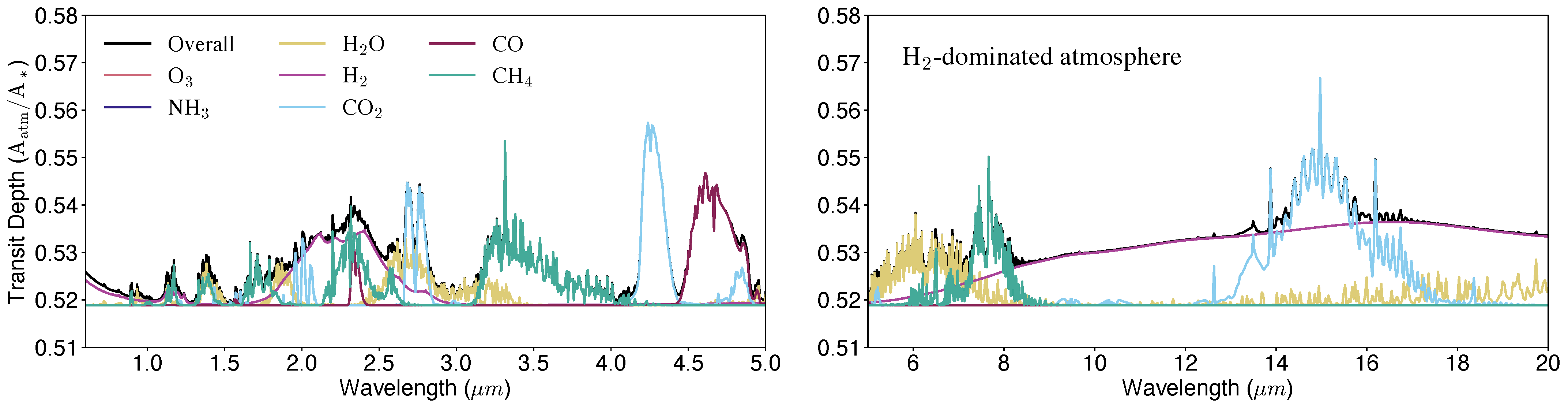
One of the foremost goals of exoplanetary science is to find the evidence for life elsewhere. Spectral biosignatures - features of a molecule or a combination of molecules with biogenic origin - are the key for remote characterization of potentially habitable exoplanets. In a series of works, I simulated the climate, photochemistry, and high-resolution transmission spectra of potentially habitable exoplanets such as TRAPPIST-1e, and estimated the prospect for JWST to detect an atmosphere - and even evidence for life - on such exoplanets. I also simulated the transmission spectra of Earth through geological time - from the very beginning of life to present day - around various types of host stars (F, G, K, and M). 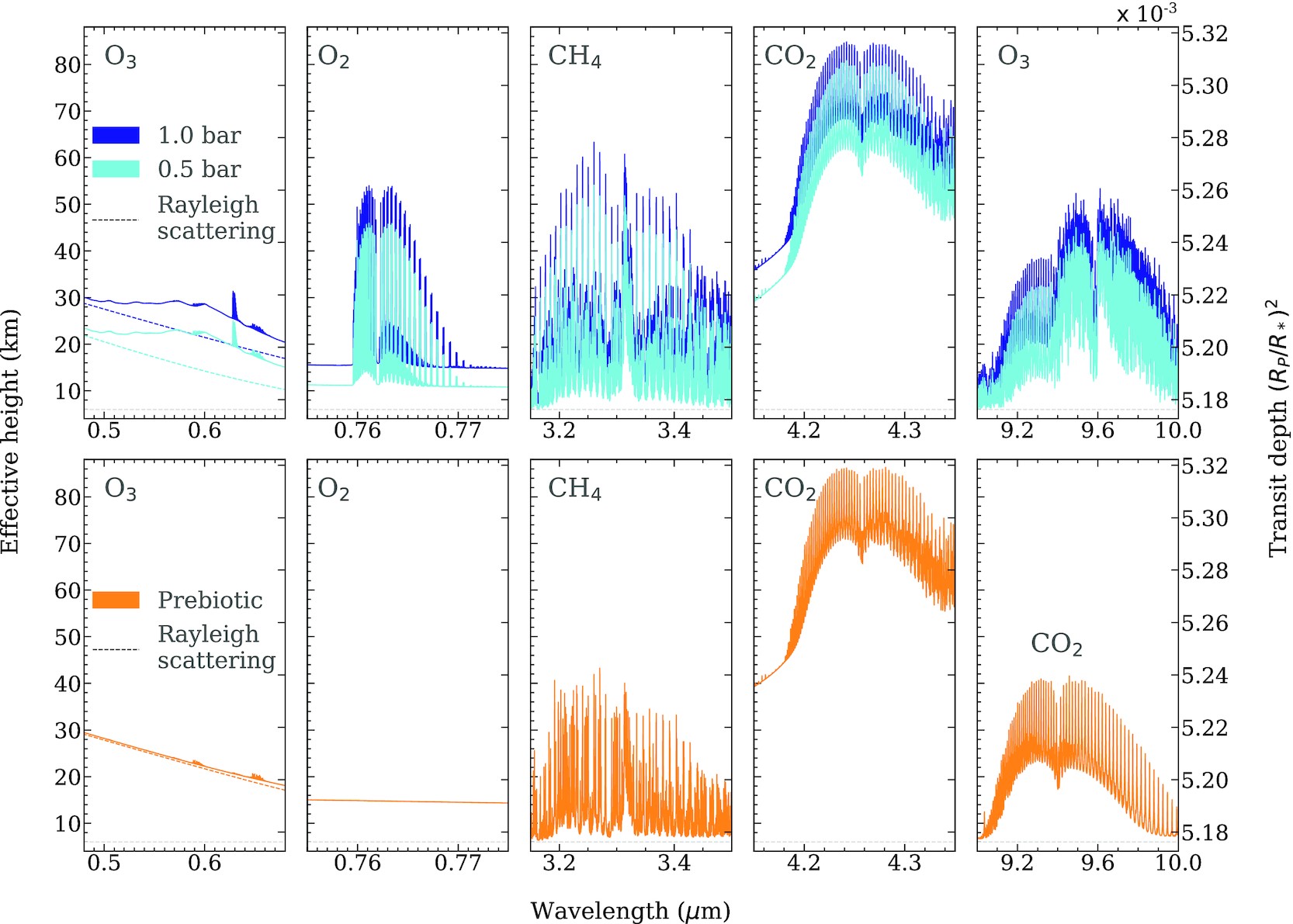
Published:
Published:
Published:
Published:
Published:
Published:
Course, Department of Physics, Cornell University, 2018
Course, Department of Earth, Atmospheric and Planetary Sciences, MIT, 2022
Course, Department of Earth, Atmospheric and Planetary Sciences, MIT, 2023