Planetary Interiors: The Compositions of Uranus and Extrasolar Sub-Neptunes
Interior and Gravity Field Models for Uranus Suggest a Mixed-composition Interior: Implications for the Uranus Orbiter and Probe
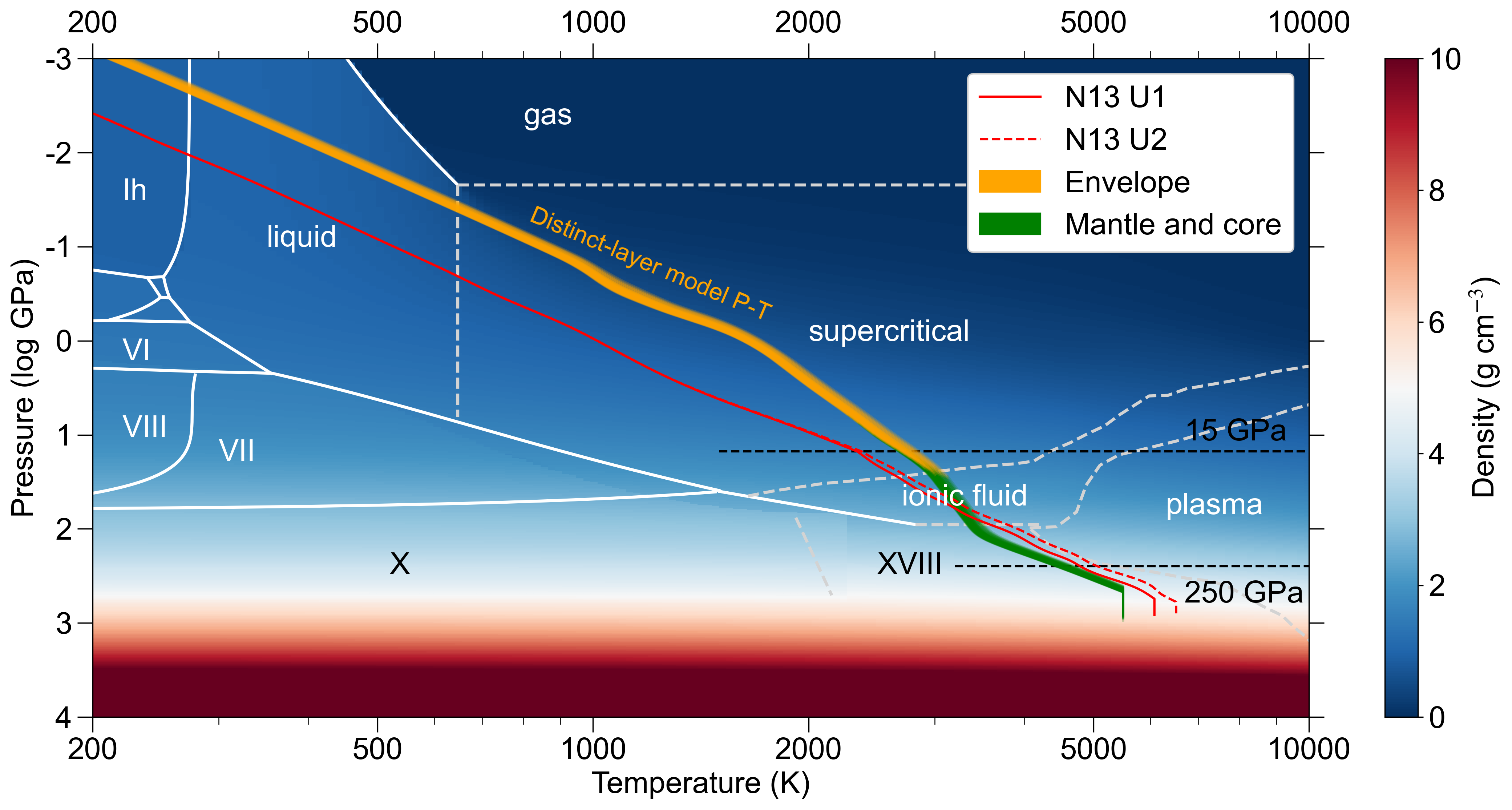
The interior composition and structure of Uranus are ambiguous. It is unclear whether Uranus is composed of fully differentiated layers dominated by an icy mantle or has smooth compositional gradients. The Uranus Orbiter and Probe (UOP), the next NASA flagship mission prioritized by the Planetary Science and Astrobiology Survey 2023-2032, will constrain the planet’s interior by measuring its gravity and magnetic fields. To characterize the Uranian interior, here we present CORGI, a newly developed planetary interior and gravity model. We confirm that high degrees of mixing are required for Uranus interior models to be consistent with the J2 and J4 gravity harmonics measured by Voyager 2. Empirical models, which have smooth density profiles that require extensive mixing, can reproduce the Voyager 2 measurements. Distinct-layer models with mantles composed of H2O-H/He or H2O-CH4-NH3 mixtures are consistent with the Voyager 2 measurements if the heavy element mass fraction, \(Z\), in the mantle \(\lesssim85\%\), or if atmospheric \(Z\gtrsim25\%\). Our gravity harmonics model shows that UOP J2 and J4 measurements can distinguish between high (\(Z\leq25\%\)) and low (\(Z=12.5\%\)) atmospheric metallicity scenarios. The UOP can robustly constrain J6 and potentially J8 given polar orbits within rings. An ice-rich composition can naturally explain the source of Uranus’s magnetic field. However, because the physical properties of rock-ice mixtures are poorly known, magnetic field generation by a rock-rich composition cannot be ruled out. Future experiments and simulations on realistic planetary building materials will be essential for refining Uranus interior models.
See more details in Lin, Seager & Weiss (2025).
Carbon-rich Sub-Neptune Interiors Are Compatible with JWST Observations
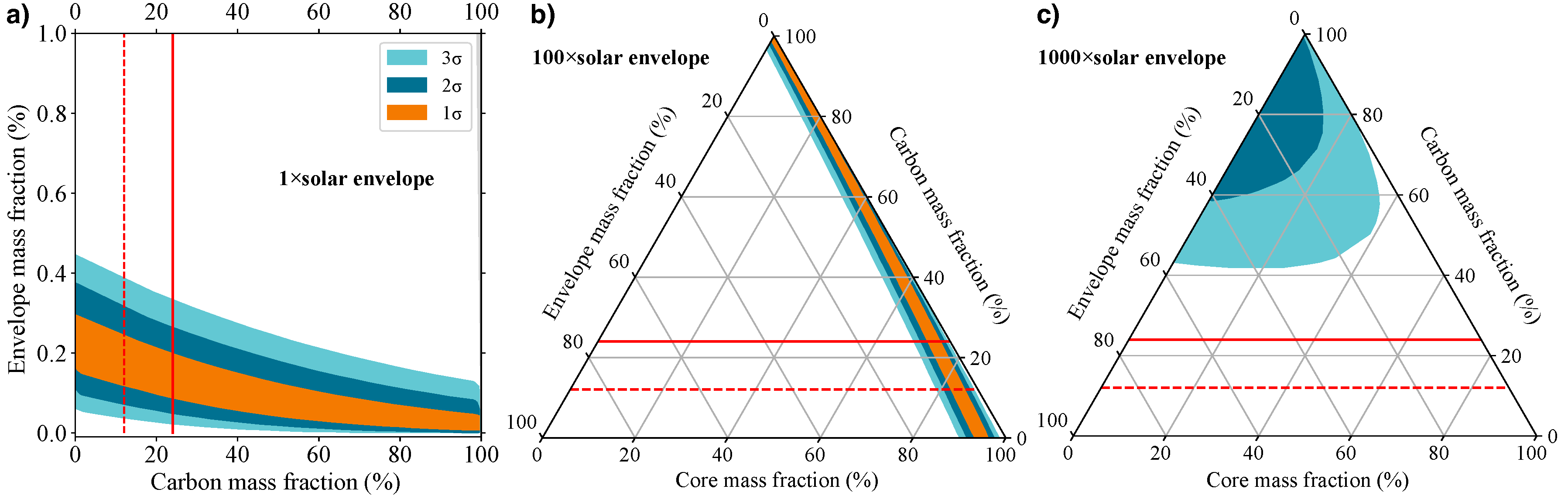
Many possible interior compositions exist for sub-Neptunes: ice-poor, ice-rich, and water-dominated interiors can all match the measured masses and radii. Motivated by a recent theory of carbon-rich planet formation outside the refractory organic carbon “soot line” and observations of carbon-rich protoplanetary disks around late M dwarfs, we propose another possible sub-Neptune composition: a carbon-rich composition consisting of an iron-silicate core, a carbon layer, and a hydrogen/helium-dominated envelope. We show that the interiors of three prototypical sub-Neptunes with high-quality spectral observations - TOI-270 d, GJ 1214 b, and K2-18 b - are consistent with carbon-rich compositions if they have \(\leq100\) times solar metallicity atmospheres. We further show that carbon-rich interiors lead to atmospheric compositions that match Hubble Space Telescope and JWST observations. Simulated carbon-rich TOI-270 d transmission spectra pass the \(\chi^2\) test under a wide range of C/O, haze, and cloud scenarios. K2-18 b spectral models are broadly consistent with observations but require additional sources for carbon species to be fully compatible. GJ 1214 b models, however, are incompatible with observations, ruling out a carbon-rich interior composition, if the atmosphere of the planet is primordial and reflects the interior C/O.
See more details in Lin & Seager (2025).