Atmospheres of White Dwarf Exoplanets
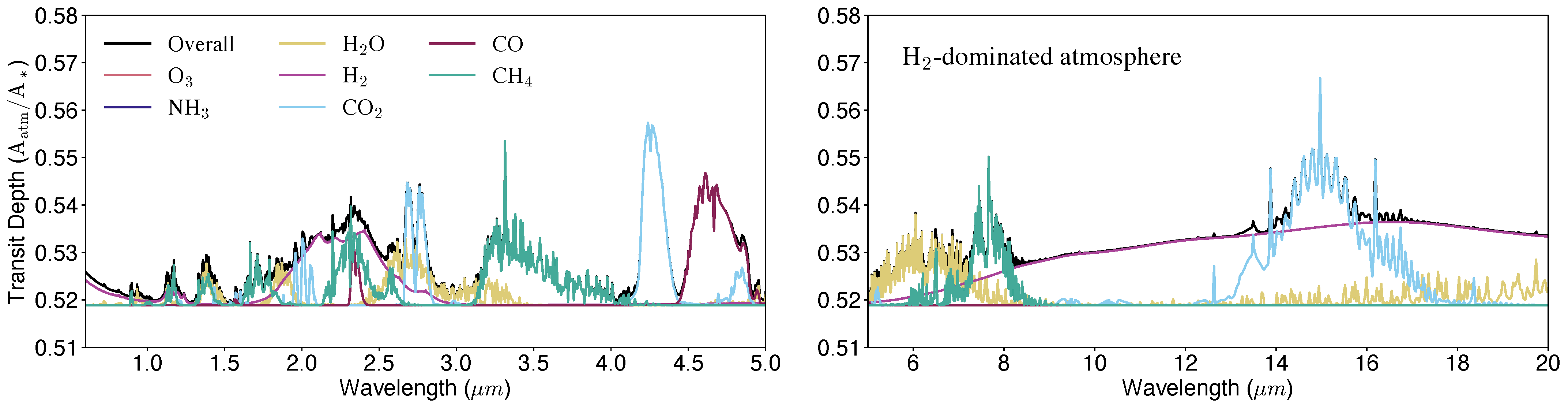
Following the discovery of the first exoplanet candidate transiting a white dwarf (WD), a “white dwarf opportunity” for characterizing the atmospheres of terrestrial exoplanets around WDs is emerging. Large planet-tostar size ratios and hence large transit depths make transiting WD exoplanets favorable targets for transmission spectroscopy; conclusive detection of spectral features on an Earth-like planet transiting a close-by WD can be achieved within a medium James Webb Space Telescope program. Despite the apparently promising opportunity, however, the post-main sequence evolutionary history of a first-generation WD exoplanet has never been incorporated in atmospheric modeling. Furthermore, second-generation planets formed in WD debris disks have never been studied from a photochemical perspective. We demonstrate that transmission spectroscopy can identify a second-generation rocky WD exoplanet with a thick (\(\sim1\) bar) H2-dominated atmosphere. In addition, we can infer outgassing activities of a WD exoplanet based on its transmission spectra and test photochemical runaway by studying CH4 buildup.
See more details in Lin et al. (2022).
Related work: Kozakis, Lin & Kaltenegger (2020).