
Atmospheres of Potentially Habitable Exoplanets
Differentiating modern and prebiotic Earth scenarios for TRAPPIST-1e: high-resolution transmission spectra and predictions for JWST
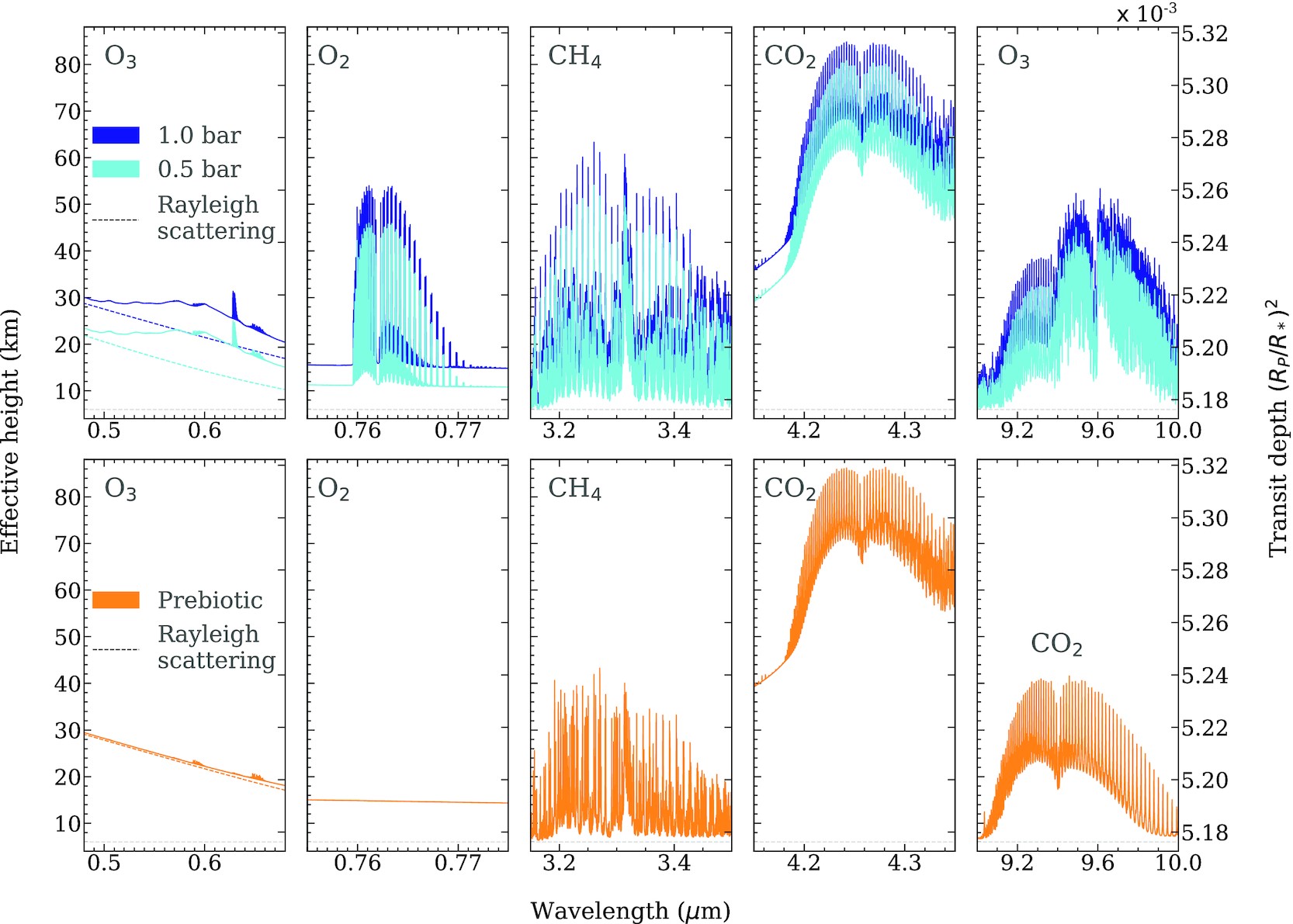
The TRAPPIST-1 system is a priority target for terrestrial exoplanet characterization. TRAPPIST-1e, residing in the habitable zone, will be observed during the James Webb Space Telescope (JWST) GTO Program. Here, we assess the prospects of differentiating between prebiotic and modern Earth scenarios for TRAPPIST-1e via transmission spectroscopy. Using updated TRAPPIST-1 stellar models from the Mega-MUSCLES survey, we compute self-consistent model atmospheres for a 1 bar prebiotic Earth scenario and two modern Earth scenarios (1 and 0.5 bar eroded atmosphere). Our modern and prebiotic highresolution transmission spectra (0.4-20 \(\mu\)m at \(R \sim100,000\)) are made available online. We conduct a Bayesian atmospheric retrieval analysis to ascertain the molecular detectability, abundance measurements, and temperature constraints achievable for both scenarios with JWST. We demonstrate that JWST can differentiate between our prebiotic and modern Earth scenarios within 20 NIRSpec Prism transits via CH4 abundance measurements. However, JWST will struggle to detect O3 for our modern Earth scenario to \(>2\sigma\) confidence within the nominal mission lifetime (\(\sim80\) transits over 5 yr). The agnostic combination of N2O and/or O3 offers better prospects, with a predicted detection significance of \(2.7\sigma\) with 100 Prism transits. We show that combining MIRI LRS transits with Prism data provides little improvement to atmospheric constraints compared to observing additional Prism transits. Though biosignatures will be challenging to detect for TRAPPIST-1e with JWST, the abundances for several important molecules - CO2, CH4, and H2O - can be measured to a precision of \(\sim0.7\) dex (a factor of 5) within a 20 Prism transit JWST program.
See more details in Lin et al. (2021).
Related work: Lin & Kaltenegger (2019).
Simulated Transmission Spectra of Earth through Geological Time and around FGKM Host Stars
Thousands of transiting exoplanets have already been detected orbiting a wide range of host stars, including the first planets that could potentially be similar to Earth. The upcoming Extremely Large Telescopes and the James Webb Space Telescope will enable the first searches for signatures of life in transiting exoplanet atmospheres. Here, we quantify the strength of spectral features in transit that could indicate a biosphere similar to the modern Earth on exoplanets orbiting a wide grid of host stars (F0 to M8) with effective temperatures between 2500 and 7000 K: transit depths vary between about 6000 ppm (M8 host) to 30 ppm (F0 host) due to the different sizes of the host stars. CO2 possess the strongest spectral features in transit between 0.4 and 20 \(\mu\)m. The atmospheric biosignature pairs O2+CH4 and O3+CH4 - which identify Earth as a living planet - are most prominent for Sunlike and cooler host stars in transit spectra of modern Earth analogs. Assessing biosignatures and water on such planets orbiting hotter stars than the Sun will be extremely challenging even for high-resolution observations. All high-resolution transit spectra and model profiles are available online: they provide a tool for observers to prioritize exoplanets for transmission spectroscopy, test atmospheric retrieval algorithms, and optimize observing strategies to find life in the cosmos. In the search for life in the cosmos, transiting planets provide the first opportunity to discover whether or not we are alone, with this database as one of the keys to optimize the search strategies.
See more details in Kaltenegger & Lin (2021).
Related work: Kaltenegger, Lin & Rugheimer (2020), Kaltenegger, Lin & Madden (2020)